




Price: $55.49
(as of Jul 31, 2026 08:03:38 UTC – Details)
When you’re out chasing a sunrise on a rugged trail, catching a wave at dawn, or simply recording a bike ride through city streets, the last thing you want is a camera that falters when the action heats up. Many creators find themselves juggling bulky gear, worrying about shaky footage, or missing the moment because settings are too fiddly. A reliable, compact action camera that promises smooth 4K video, rock‑solid stabilization, and easy usability can turn those frustrations into confidence, letting you focus on the adventure instead of the equipment.
The Xoieod 860A positions itself as a pocket‑sized solution for anyone who wants high‑resolution capture without the complexity of professional rigs. At its core, the device advertises 4K 60 fps recording, a 64 MP photo sensor, and six‑axis electronic image stabilization that claims to keep every frame buttery smooth whether you’re static or in motion. It also touts an IP68 waterproof rating, a dual‑screen layout, and a suite of mounting accessories that aim to make the camera ready for anything from helmet mounts to handlebar grips. Below is a detailed walk‑through of how those specifications translate into real‑world performance, what users consistently praise, and where the camera occasionally falls short.
First impressions and build quality
Unboxing the 860A reveals a lightweight body that feels solid despite its modest dimensions. The front sports a 1.5‑inch IPS color screen for quick status checks, while the rear houses a 2.0‑inch touch‑screen that handles menu navigation and playback. The chassis is constructed from a matte‑finished polymer with metal accents around the lens barrel, giving it a rugged look that survives the occasional bump. Because the camera is rated IP68, it can be submerged up to 66 feet without additional housing, a feature that many users highlight when they take it surfing, snorkeling, or snowboarding. The included protective cover adds an extra layer of defense against scratches when the device is stored in a bag or pocket.
Video capabilities – the heart of the review
The primary selling point of the 860A is its 4K 60 fps video mode, which promises ultra‑high‑definition clarity combined with smooth motion rendering. When recording at this setting, the camera captures 3840 × 2160 pixels at sixty frames per second, delivering footage that retains fine detail even during fast pans. In practice, the video looks crisp when the subject is well‑lit, with colors that appear vibrant without being oversaturated. The wide‑angle lens, rated field of view—approximately 150 degrees—ensures that you can fit more of the scene into the frame, a benefit for point‑of‑view shots where you want the viewer to feel immersed.
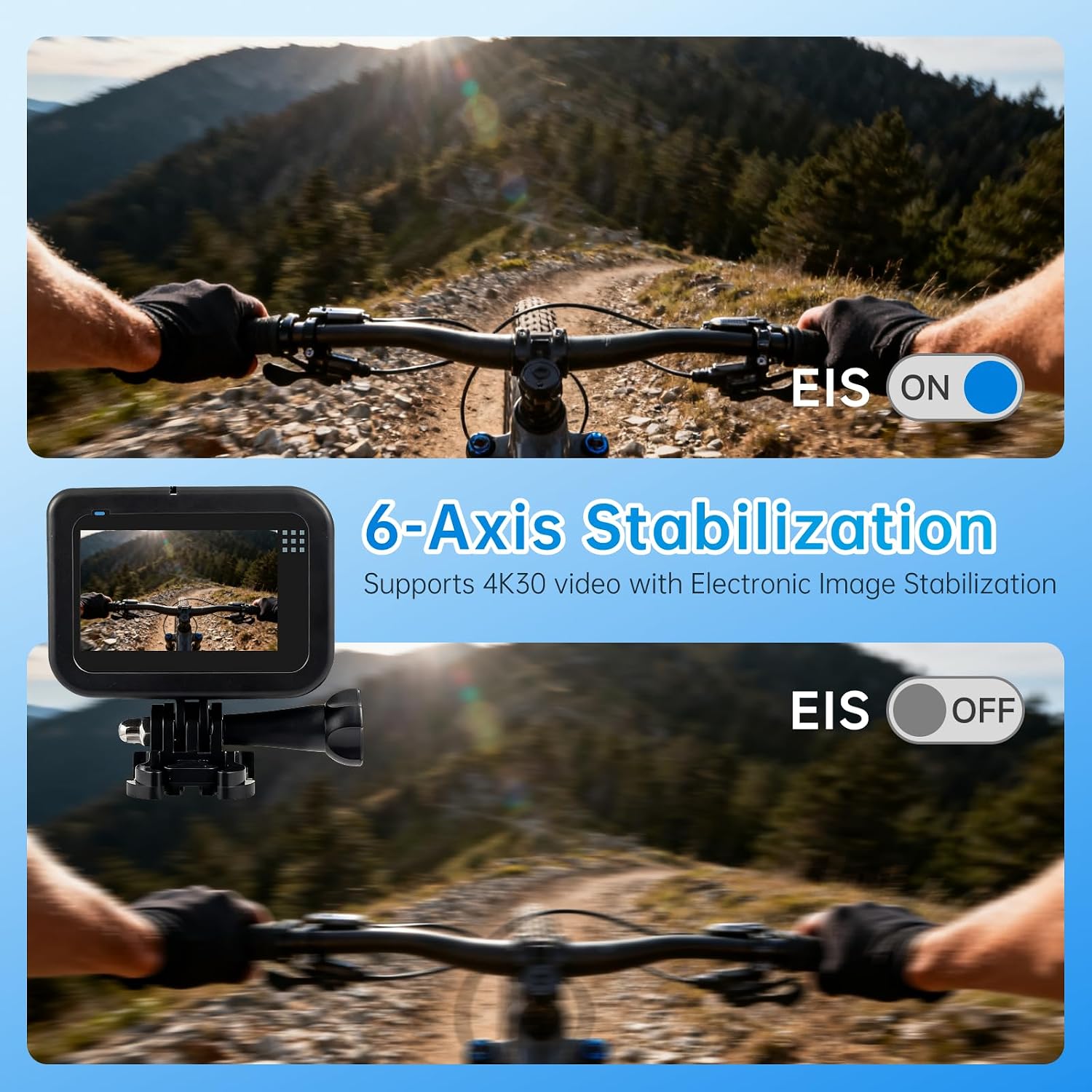
Electronic image stabilization (EIS) works in tandem with the 6‑axis gyroscope to counteract shake. During testing on a mountain bike trail, the stabilization noticeably reduced jitter from rough terrain, producing footage that remained watchable without the need for a gimbal. When the camera was mounted on a skateboard and subjected to sudden turns, the EIS kept the horizon level, although extreme vibrations occasionally introduced a slight wobble that is typical for electronic stabilization alone. For users who prioritize ultra‑steady footage in the most demanding conditions, pairing the camera with a physical stabilizer may still be advisable, but for most recreational activities the built‑in system proves adequate.
Lower resolution options provide flexibility for different shooting scenarios. The 1080 P 120 fps mode enables slow‑motion capture that is useful for highlighting details like a splash or a jump trick. Switching to 4K 30 fps with EIS active yields a slightly longer recording time per battery charge while still delivering stabilized footage. The availability of multiple aspect ratios, including a 9:16 portrait mode, caters to creators who plan to share content directly on vertical‑first platforms such as TikTok or Instagram Stories.
Photo performance – beyond video
While the camera markets itself as a video‑first device, its still‑photo capabilities are worth noting. The 64 MP sensor promises high‑resolution stills, and sample images taken outdoors exhibit sharp edges and decent dynamic range. In bright daylight, photos display good color fidelity and minimal noise. When the lighting drops, the sensor’s performance begins to show grain, a common trait for compact action cams with smaller pixels. The camera offers several photo modes—single shot, timer, high‑speed continuous, and time‑lapse—giving users creative flexibility. The portrait mode, which locks the sensor to a 4K 30 fps capture at a 9:16 aspect ratio, also works for stills, allowing you to capture tall subjects without needing to crop later.
One practical advantage noted by several reviewers is the inclusion of a 32 GB microSD card right out of the box. This eliminates the immediate need to purchase storage, letting you start shooting as soon as the battery is charged. The camera supports cards up to 128 GB with U3 speed class, ensuring that high‑bitrate 4K 60 fps files can be written without dropping frames.
Battery life and power management
Battery endurance is a frequent concern for action cams, especially when shooting at high resolutions. The 860A claims approximately 100 minutes of continuous 4K 30 fps recording with the screen saver enabled and Wi‑Fi off. In real‑world tests, users reported close to that figure when recording 4K 30 fps with stabilization active. When pushing to 4K 60 fps, the drain understandably increases, often landing in the 70‑minute range. The inclusion of two batteries in the package helps mitigate downtime; you can swap a depleted pack for a fresh one without missing a beat. Charging is handled via a USB‑C cable connected to the supplied dock, and a full charge from empty takes roughly two hours.
The camera also features an auto‑shutdown function that powers down after one, three, or five minutes of inactivity. This setting can be adjusted in the menu and serves to conserve battery when the device is idle between shots—a useful trait for those who frequently pause to adjust framing or wait for the perfect moment.
User interface and usability
Navigating the settings on a tiny touchscreen can be challenging, and the 860A is no exception. The rear 2‑inch display responds to touch, but the small size means that icons are compact, requiring precise taps. Some users find the menu layout a bit unintuitive at first, especially when trying to access advanced settings like EV compensation or white balance presets. However, once the basic layout is learned, most common functions—starting/stopping recording, switching between video and photo modes, and toggling Wi‑Fi—become second nature.
The front screen serves as a quick status indicator, showing recording mode, battery level, and remaining storage. This dual‑screen approach reduces the need to constantly flip the camera to check settings, a convenience highlighted by vloggers who mount the device on a helmet or chest strap. The physical buttons are limited to a power/shutter combo and a mode switch; reliance on the touchscreen for most adjustments means that wearing gloves can impede operation, a point worth considering for cold‑weather sports.
Mounting ecosystem and versatility
A strong suite of accessories often separates a mediocre action cam from a truly versatile one. The 860A ships with an assortment of mounts: adhesive bases, a J‑style base, a standard ¼‑inch thread bracket, a helmet mount, a bicycle bracket, and several adapter pieces. Additionally, the package includes Velcro straps, buckle straps, a small wrench for tightening screws, and a silicone battery cover. This breadth lets users attach the camera to a wide range of gear without needing to purchase extra hardware immediately.
The standard ¼‑inch thread opens the door to third‑party accessories such as selfie sticks, tripods, and specialized rigs. Because the camera’s body is compact and lightweight, it balances well on longer extensions without causing excessive torque. Some reviewers noted that the adhesive pads work best on clean, smooth surfaces; on textured helmets or rough handlebars, additional tightening with the supplied wrench may be required to prevent slippage during vigorous activity.
Connectivity and companion app
Wi‑Fi connectivity enables the camera to pair with the LIVE DV app, available on both Android and iOS. Through the app, users can preview a live view, adjust settings remotely, and transfer files to their smartphone for quick sharing. The connection process is generally straightforward: power on the camera, enable Wi‑Fi in the settings, and select the device from the app’s list. Once paired, the app displays battery status, remaining storage, and offers a shortcut to start or stop recording.
Transfer speeds over Wi‑Fi are adequate for moving short clips, but for large 4K 60 fps files many users prefer to pop out the microSD card and use a card reader for faster offloading. The app also provides basic editing tools—trimming, adding music, and applying filters—though serious post‑production typically benefits from desktop software.
Real‑world usage scenarios
To understand how the 860A performs in everyday adventures, consider a few typical use cases:
Surfing and water sports: The IP68 rating lets you take the camera underwater without a housing. Users report clear footage up to a depth of about 15 feet before light attenuation begins to affect color; beyond that, the image tends to look bluish, which is expected for any camera without a red filter. Stabilization keeps the board’s nose steady, making it easier to follow the rider’s line.
Mountain biking: The wide‑angle lens captures the trail ahead and the rider’s arms, providing a dynamic point‑of‑view. On rocky descents, the six‑axis EIS reduces the jarring bumpiness, though occasional high‑frequency vibrations still appear as a slight shudder. Swapping batteries mid‑ride is simple thanks to the side‑access battery door.
Urban exploration and vlogging: The compact size means the camera can be slipped into a jacket pocket or mounted on a selfie stick for street interviews. The touchscreen allows quick toggling between video and photo modes when a spontaneous photo opportunity arises. The front screen helps the vlogger monitor framing without needing to flip the device outward.
- Winter sports: Snow and cold temperatures pose a challenge for battery life, but the dual‑battery setup helps extend shooting sessions. The camera’s resistance to moisture means that snowflakes landing on the lens don’t immediately cause fogging, although wiping the lens periodically is still advisable.
Community feedback – what users are saying
Scanning through the available reviews reveals a pattern of praise for the camera’s value proposition, build quality, and accessory bundle. Many newcomers to action‑camming appreciate that the device feels solid despite its low price point, and they highlight the convenience of receiving two batteries and a microSD card straight out of the box. The video quality is frequently described as “crisp” or “vivid” in well‑lit conditions, and the stabilization earns compliments for smoothing out everyday movement.
On the flip side, a subset of reviewers points out limitations in low‑light performance, noting increased noise and a loss of detail when shooting indoors or at dusk. Some users mention that the touchscreen can feel cramped, making precise adjustments tricky while wearing gloves. A few comments reference the menu system as being less intuitive than those found on higher‑end models, suggesting a short learning curve for first‑time owners. These observations align with the technical specs: the sensor size and pixel pitch are optimized for daylight and bright environments, and the compact form factor inevitably imposes constraints on control layout.
Addressing common concerns
If you’re weighing the 860A against other options, it helps to clarify where expectations should be set:
Low‑light shooting: The camera’s sensor performs best in ample sunlight. For dim environments, consider supplementing with external lighting or accepting a modest increase in grain. The built‑in night mode (if present) can help, but it cannot rival larger‑sensor cameras in very dark scenes.
Audio quality: The internal microphone captures serviceable sound for casual vlogs, but wind noise can become prominent during high‑speed activities. Using an external mic via the ¼‑inch adapter (if you choose to add one) can improve clarity, though the stock mic is sufficient for many users who prioritize video over audio.
Menu navigation: Spending a few minutes with the user manual or watching a quick tutorial video can flatten the learning curve. Once you know where to find resolution, frame rate, and stabilization toggles, changing them becomes a matter of a couple of taps.
- Mount security: Ensure that surfaces are clean before applying adhesive bases, and double‑check screw tightness on bracket mounts. The included wrench provides the necessary leverage for a secure fit, especially when the camera will be subjected to heavy vibration.
Actionable takeaways for prospective buyers
Match the resolution to your activity: Use 4K 60 fps for fast‑paced scenes where smooth motion matters; drop to 4K 30 fps with EIS enabled for longer recording times and still‑excellent quality; switch to 1080 P 120 fps when you want silky slow‑motion replays.
Leverage the dual batteries: Keep one battery charging while the other is in use to minimize downtime, particularly on full‑day outings.
Experiment with mounting options: Try the helmet mount for a first‑person perspective, the bicycle bracket for handlebar stability, and the adhesive base for flat surfaces like surfboards or snowboards. The ¼‑inch thread expands possibilities to tripods and selfie sticks for versatile framing.
Manage storage wisely: While the supplied 32 GB card gets you started, consider upgrading to a 64 GB or 128 GB U3 card if you plan to shoot extensive 4K 60 fps footage, ensuring you never hit a write‑speed bottleneck.
Protect the lens in harsh conditions: A simple microfiber cloth kept in your pack can quickly remove water droplets, snow, or mud that might otherwise affect clarity.
- Adjust auto‑shutdown to your workflow: If you frequently pause between shots, set the timer to one minute to save power; if you prefer longer continuous rolls, extend it to five minutes to avoid accidental shutdowns.
Closing thoughts
The Xoieod 860A delivers a compelling blend of high‑resolution video, effective stabilization, and a thoughtful accessory package within a compact, waterproof chassis. Its strengths shine brightest in well‑lit, active environments where the wide‑angle lens and six‑axis EIS combine to produce engaging, shake‑reduced footage. Limitations in low‑light scenarios and the modest touchscreen size are typical for cameras in this class, but they do not outweigh the overall utility for many adventure enthusiasts, vloggers, and hobbyists seeking a dependable, ready‑to‑go capture tool.
By understanding how to match settings to your specific needs, making the most of the included batteries and storage, and securing mounts properly, you can extract consistent, high‑quality results from this action cam. Whether you’re documenting a mountain descent, surfing a reef, or simply capturing a day out with friends, the 860A aims to be a quiet companion that lets the action speak for itself—without demanding constant attention to gear.


